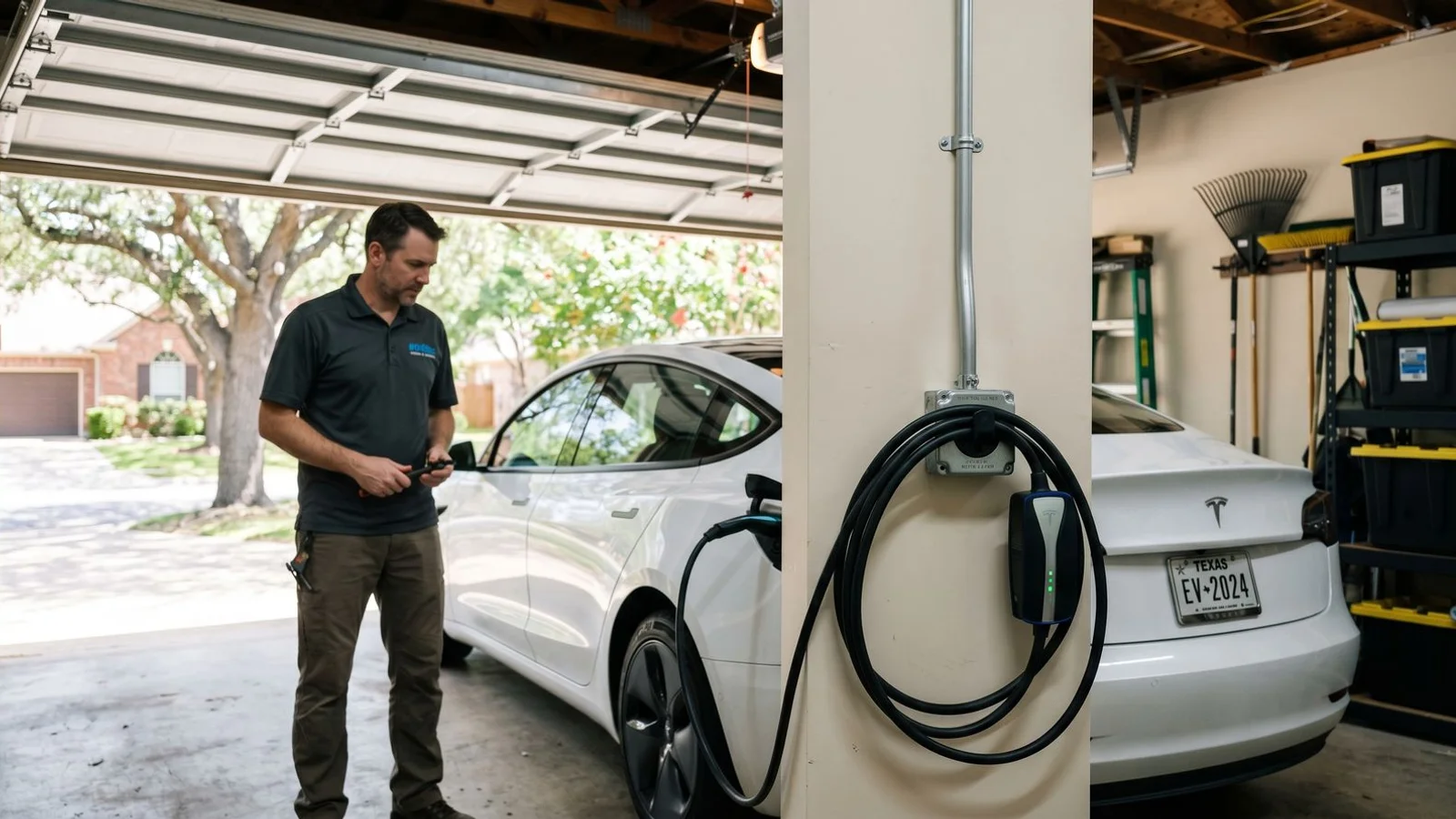
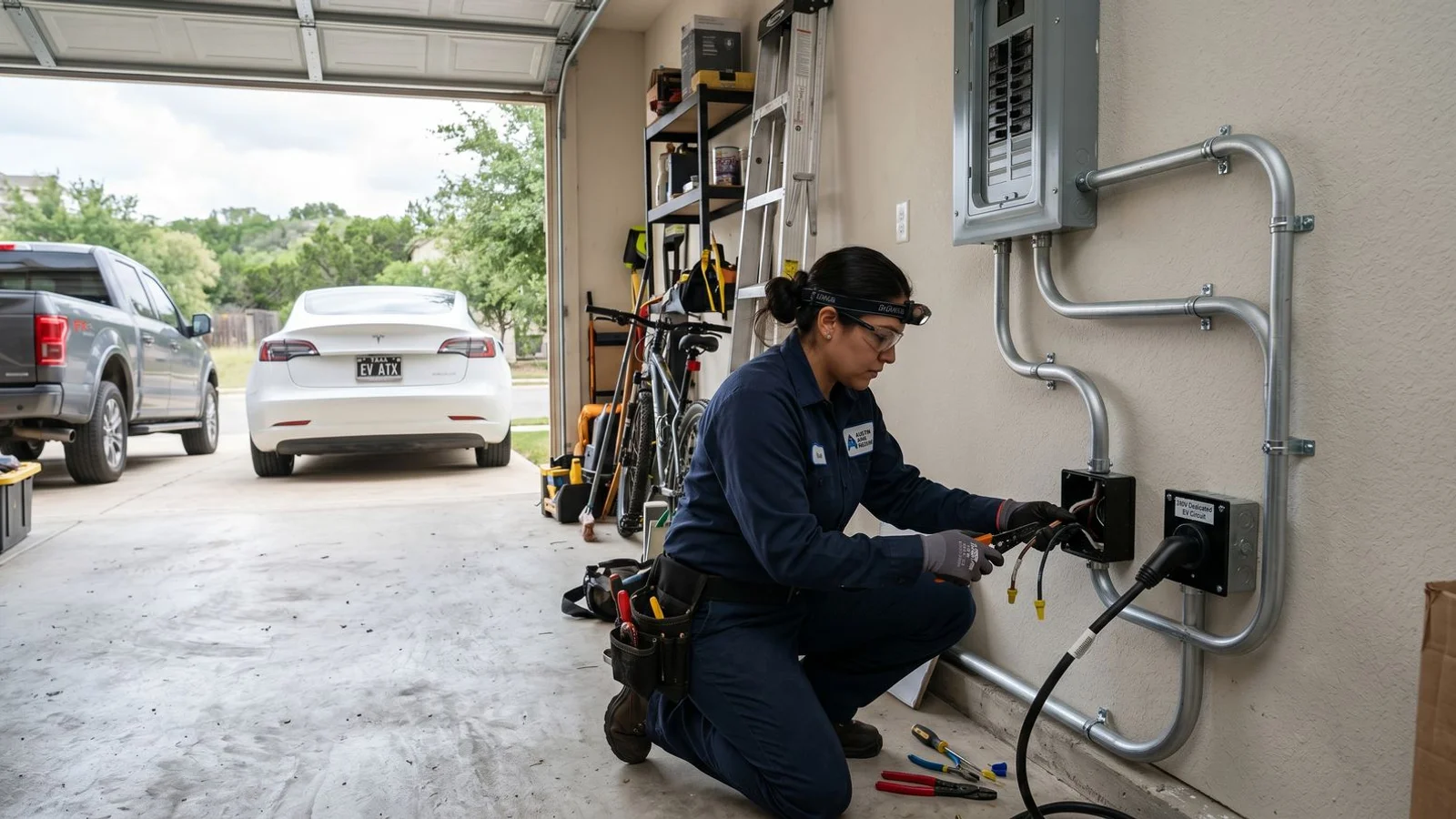
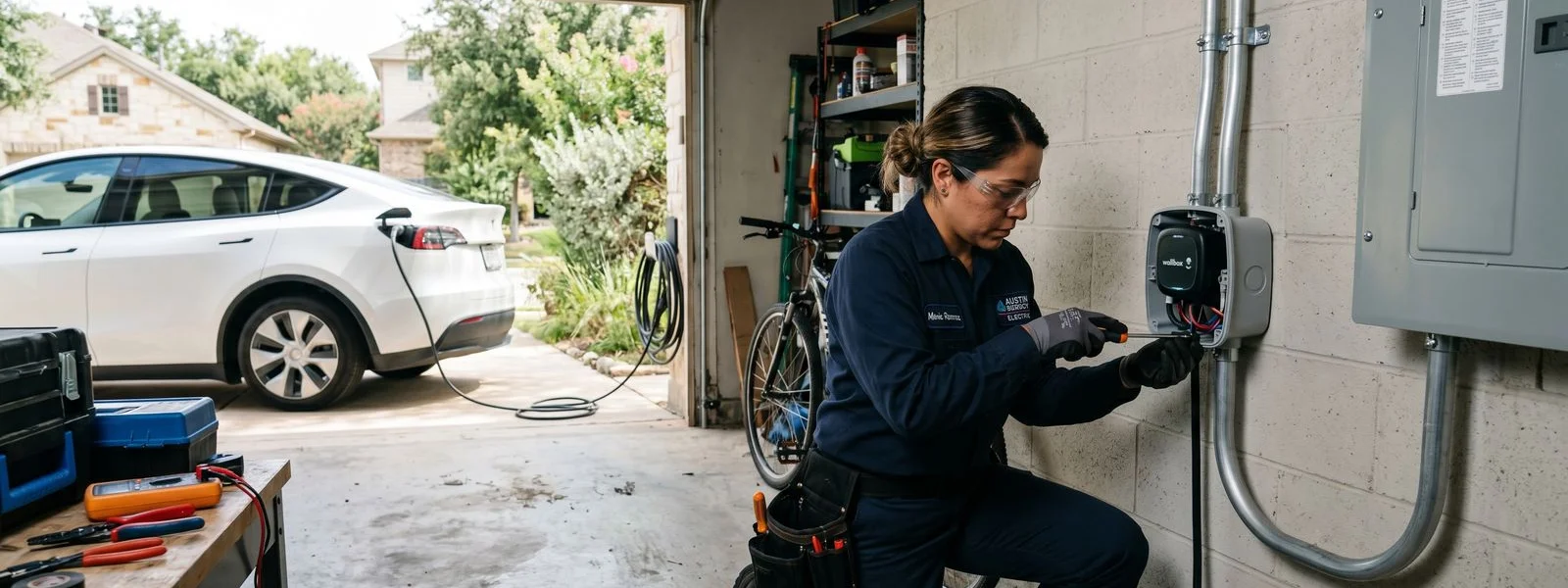
NEMA 14-50 vs NEMA 6-50: Which EV Outlet Do You Need?
NEMA 14-50 has a neutral; 6-50 doesn't. Which chargers use which, amperage, cost, and our recommendation by setup.
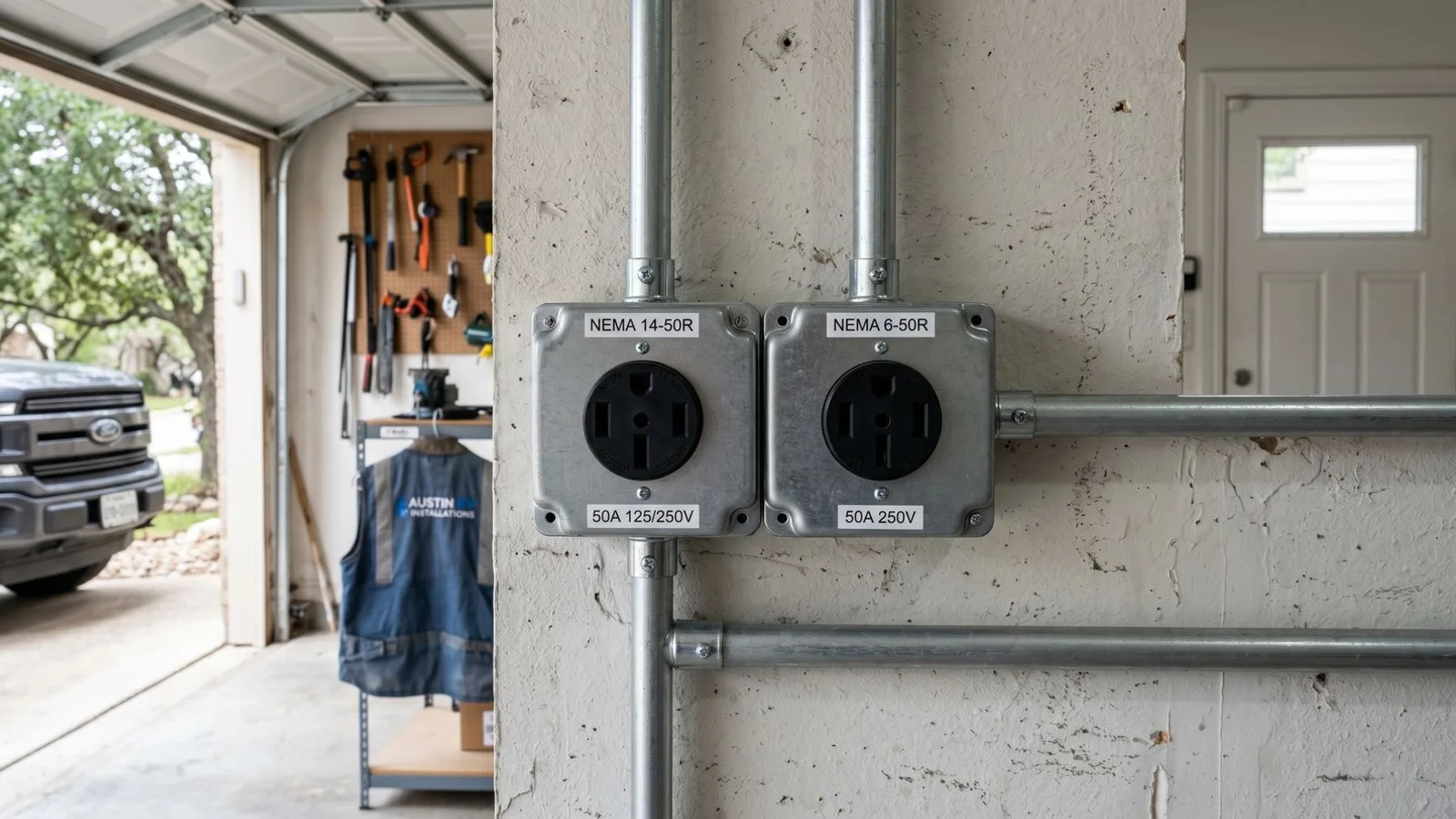
We see a clear pattern when local drivers transition from a slow Level 1 cord to a faster overnight charging setup. The upgrade process almost always stalls at one specific choice. A dedicated 240V outlet is the best way to ensure you wake up to a fully charged battery.
Our technicians at Austin EV Charger Installation answer questions about the nema 14-50 vs 6-50 debate every single day.
Both of these plugs easily deliver up to 50 amps of power. The physical layout of your specific portable Level 2 charger determines your installation path.
We are going to break down the technical differences between these two common standards. Let’s look at the hardware requirements, code regulations, and the exact outlet you need.
The basic difference
We will start by examining the core wiring differences behind the wall. The NEMA 14-50 requires four wires including a neutral, while the 6-50 uses only three wires without a neutral. Safety requires matching the right outlet to the correct copper wiring.
Our team frequently repairs melted, cheap receptacles that were not rated for this intense duty cycle. A high-quality commercial unit is an absolute necessity. Industrial options like the Hubbell HBL9450A are built to handle the heat of daily charging.
| Feature | NEMA 14-50 | NEMA 6-50 |
|---|---|---|
| Prong Count | 4 prongs | 3 prongs |
| Wiring Required | 6/3 NM-B (Includes neutral wire) | 6/2 NM-B (No neutral wire) |
| Common Historical Use | RV parks, electric ranges | Heavy welding equipment |
| EV Popularity | The current industry standard | Less common, legacy applications |
We recommend reviewing these specifications before buying wire. The physical shapes of these plugs are completely different and they are not interchangeable.
Which EV chargers use which
Our technicians install dozens of different equipment brands each month. The current market heavily favors the four-prong 14-50 plug for the vast majority of modern chargers. Over 80% of consumer plug-in charging stations sold in 2026 ship with this plug by default.
Chargers utilizing the NEMA 14-50 plug:
- Tesla Mobile Connector: The standard Gen 2 adapter uses this four-prong layout.
- ChargePoint Home Flex: This premium unit defaults to a 14-50 connection for plug-in mode.
- Emporia EV Charger: A highly rated smart charger that ships standard with this plug.
- Wallbox Pulsar Plus: Another popular smart unit that utilizes the four-prong standard.
- Ford Mobile Power Cord: The default charging cable included with the F-150 Lightning and Mustang Mach-E.
We rarely see three-prong plugs on modern residential hardware. Some manufacturers offer them as a special order item. A few specific scenarios still call for this older configuration.
Equipment utilizing the NEMA 6-50 plug:
- Grizzl-E Classic: This rugged charger offers a NEMA 6-50 ev charger option for garages with existing welder outlets.
- Older Industrial Adapters: Legacy portable units often use this three-prong standard.
- Custom Commercial Hardware: Certain fleet charging solutions rely on this simplified wiring.
Our standard advice is to check the cord in your trunk before making any electrical decisions. If you recently purchased an aftermarket Level 2 unit, you almost certainly have a 14-50 plug.
Why the neutral matters (and why it usually doesn’t)
We often explain the purpose of the neutral wire to curious homeowners. This extra conductor allows an outlet to supply both 120V and 240V simultaneously, but electric vehicles only use the 240V feed. Large recreational vehicles use the 120V feed to run interior lights and small appliances.
Our electrical code requires the neutral wire for these dual-voltage applications. An electric vehicle pulls pure 240V power for charging. The standard J1772 and NACS charging handles do not even have a physical pin to receive a neutral connection.
We always route the neutral wire into the box during a new four-prong installation. This step ensures your garage remains fully compatible with a future RV.
Pro-Tip for Future Upgrades: You can simply cap the neutral wire inside the junction box if you decide to switch to a hardwired charger later. This keeps your options open without requiring new wire to be pulled.
Our approach gives you maximum flexibility for a small incremental cost. The extra conductor makes the materials slightly more expensive than a three-wire setup. Most homeowners find this minor expense worthwhile for the added versatility.
Code requirements (both)
We strictly adhere to modern safety standards for every single installation. The 2023 National Electrical Code mandates a dedicated 50A circuit and a Ground Fault Circuit Interrupter breaker for both plug types. Article 625.54 specifically outlines these rules for all residential charging infrastructure.
Our team installs a specialized GFCI breaker in your main panel to meet this specific rule. Portable charging cables already contain built-in ground fault protection. Stacking two safety devices on the same circuit sometimes causes annoying nuisance tripping.
We frequently suggest hardwiring your equipment to bypass this overlapping safety feature entirely. A hardwired connection legally avoids the need for an expensive GFCI breaker. Both plug-in options require strict adherence to local laws.
Mandatory 2026 NEC specifications for a 240v outlet for ev:
- Dedicated 240V Circuit: The line cannot share power with any other appliances or lights.
- 50A Double-Pole Breaker: The breaker must be accurately sized for the receptacle rating.
- 6 AWG Copper Conductors: A 14-50 requires three conductors plus ground, while a 6-50 requires two conductors plus ground.
- GFCI Protection: Breaker-style protection is legally required for all plug-in applications.
- Commercial-Grade Receptacle: The unit must be rated for continuous heavy-duty loads.
- Permits and Inspections: You can review the full breakdown in our guide detailing What a Code-Compliant 240V EV Outlet Install Includes.
Cost difference
We track material prices closely to provide accurate estimates for local homeowners. The final cost difference between installing a 14-50 and a 6-50 is usually under forty dollars for a typical garage setup. The primary cost variance comes down to the extra copper wiring required for the neutral line.
Our suppliers currently price 6/3 cable slightly higher than 6/2 cable. This extra neutral conductor adds roughly two dollars per foot to the material total. A standard 20-foot wire run in an Austin garage only increases the final bill by about forty dollars.
| Material Component | Impact on Final Price |
|---|---|
| GFCI Circuit Breaker | Identical cost for both options ($100 to $150) |
| Commercial Receptacle | Nearly identical cost for both configurations |
| Copper Wiring | Adds roughly $2 per foot for the neutral wire |
We must install an expensive GFCI breaker for either plug type. These specialized safety devices cost between $100 and $150 regardless of the receptacle you choose. The high-quality Hubbell units carry nearly identical price tags.
Our final invoice for a four-prong installation is rarely more than a hundred dollars higher than a three-prong job. The long-term value of a versatile plug easily justifies this small upfront premium.
Our recommendation
We strongly advise installing the NEMA 14-50 for almost every residential project. This four-prong setup is the undisputed standard across the automotive industry and provides the most flexibility. Your new outlet will work flawlessly with current hardware and whatever vehicle you purchase next.
Our experience shows that a universal connection also provides a slight boost to your home’s resale appeal. Future buyers will appreciate a garage that is already equipped for their specific charging cable.
Key reasons to standardize on the four-prong layout:
- Broad Compatibility: It supports everything from a Ford Lightning to a standard recreational vehicle.
- Future-Proofing: You avoid needing a costly rewire when you change vehicle brands.
- Home Equity: Standardized EV infrastructure is a highly attractive feature for prospective homebuyers.
We take a different approach if you already own specific three-prong equipment. A specialized NEMA 6-50 ev charger should simply be matched with its corresponding wall socket. There is zero functional benefit to buying an adapter just to use a four-prong outlet.
Our technicians will gladly install the three-prong setup to match your existing hardware perfectly. You should always build the electrical circuit to fit the tools you currently possess. An outdoor installation requires an in-use weatherproof cover to protect the connection from rain.
Bottom line
We hope this breakdown of the nema 14-50 vs 6-50 debate clarifies your next steps. The four-prong 14-50 is the best choice for most homes, while the 6-50 is only necessary if your existing charger requires it. A three-prong setup makes sense only when your existing cord demands it.
Our team is ready to help you handle the permits and complete a safe installation. Every project requires proper GFCI protection and a dedicated circuit breaker.
See our outlet install service to schedule your local upgrade today.
Frequently Asked Questions
What's the difference between 14-50 and 6-50? +
Which does my charger need? +
Is one safer than the other? +
Ready to talk specifics?
See our NEMA 14-50 Outlet service page for pricing and what's included, or get a free flat-rate quote.