Vehicle-Specific Charging: Matching a Charger to Your EV
Onboard limits and connectors differ by EV. Charger matches for Tesla, Rivian, Mach-E, Bolt, and Ioniq 5, plus J1772 vs NACS.
Our team often sees the same surprise from new electric vehicle owners transitioning to faster overnight setups.
You buy a powerful wall station and expect lightning-fast speeds. Then you realize your battery is filling up much slower than expected. This happens because your home hardware has a maximum output, but your vehicle has its own strict limit.
The slower of the two numbers always wins.
We want to help you find the perfect ev charger for my car by looking at the whole picture. Let’s look at the data and explore a few practical ways to match your equipment.
What “onboard charger” means
When you plug into a Level 2 home station, the wall unit simply sends AC electricity to your vehicle. The direct answer is that the car’s onboard charger limit ev dictates your true speed, acting as a rectifier to convert AC power from your house into DC power for the battery.
We consistently see buyers overspend on equipment their vehicle cannot fully utilize. The onboard charger has a maximum AC current it can safely accept. Typical maximums are 32 amps, 40 amps, or 48 amps depending on the exact model.
If your internal hardware caps at 32 amps, plugging into a massive 48-amp wall unit still only gets you 32 amps.
To avoid overpaying, keep these electrical realities in mind:
- The 80 Percent Rule: The National Electrical Code requires continuous loads to run at 80 percent of the circuit breaker rating.
- Breaker Sizing: A full 48-amp charging speed requires a dedicated 60-amp breaker.
- Panel Capacity: Many standard 200-amp residential panels struggle to support a new 60-amp circuit without a major service change.
Our field experience shows that sticking with a 32-amp or 40-amp charging speed often avoids a $1,500 to $3,500 electrical panel upgrade while still delivering a full overnight charge.
Onboard limits for common Austin EVs
The onboard limit represents the absolute maximum alternating current your specific vehicle model can accept from a home station. Our technicians always recommend verifying these exact figures for your trim level, as they directly translate to the miles of range you gain per hour.
Real-world charging speeds depend heavily on battery temperature, state of charge, and local climate.
| Vehicle | Onboard max (AC) | Mi/hr at max |
|---|---|---|
| Tesla Model 3 LR | 48A | ~44 |
| Tesla Model 3 SR | 32A to 48A (varies by year) | ~30 to 42 |
| Tesla Model Y | 48A | ~44 |
| Tesla Model S/X | 48A | ~32 to 37 |
| Tesla Cybertruck | 48A+ | ~38 to 42 |
| Ford Mustang Mach-E (extended range) | 48A | ~38 |
| Ford Mustang Mach-E (standard) | 32A | ~25 |
| Ford F-150 Lightning | 48A or 80A (Charge Station Pro) | ~30 or ~50 |
| Rivian R1S / R1T | 48A | ~33 |
| Chevy Bolt EV / EUV | 32A | ~25 |
| Chevy Equinox EV | 48A | ~36 |
| Chevy Silverado EV | 48A+ | ~35 |
| Hyundai Ioniq 5 (newer firmware) | 48A | ~35 |
| Hyundai Ioniq 5 (older firmware) | 32A to 40A | ~24 to 30 |
| Kia EV6 | 32A to 48A (trim-dependent) | ~24 to 36 |
| VW ID.4 | 32A | ~25 |
| Audi Q4 e-tron | 32A | ~25 |
| Polestar 2 | 48A (newer) | ~33 |
| Mercedes EQ | 48A | ~33 |
Connector type: J1772 vs NACS
Beyond amperage, the physical plug shape determines your hardware compatibility. The primary debate between j1772 vs nacs comes down to the manufacturing year of your electric vehicle.
- J1772: This is the legacy Level 2 connector used by almost all non-Tesla electric vehicles built through the 2024 model year.
- NACS (SAE J3400): This is the North American Charging Standard originally developed by Tesla and now adopted by the wider industry.
Our industry saw a massive shift heading into 2025 and 2026. Major brands like Ford, General Motors, Rivian, and Hyundai are now shipping vehicles with native NACS ports. The SAE J3400 standard creates a universal hardware experience across nearly all new models.
Practical implications for your garage:
- Tesla Owners: Your vehicle is NACS native, so a Tesla Wall Connector is ideal, though any J1772 charger combined with an adapter works perfectly.
- 2024 or Older Non-Tesla: These use J1772 natively. Any J1772 charger or a Universal Wall Connector works beautifully, but a standard Tesla Wall Connector requires an adapter.
- 2025+ Non-Tesla with NACS: These work natively with a Tesla Wall Connector or Universal unit. Older J1772 chargers still work perfectly using a NACS-to-J1772 adapter.
For more on cross-brand setups: Installing a Tesla Charger for a Non-Tesla EV.
How to match charger to car
Matching your hardware requires looking at your current vehicle capabilities and your long-term garage plans. We suggest building a setup that maximizes your current charging speeds without requiring unnecessary electrical upgrades.
Picking the Right Connector
A quick decision tree makes the hardware choice simple:
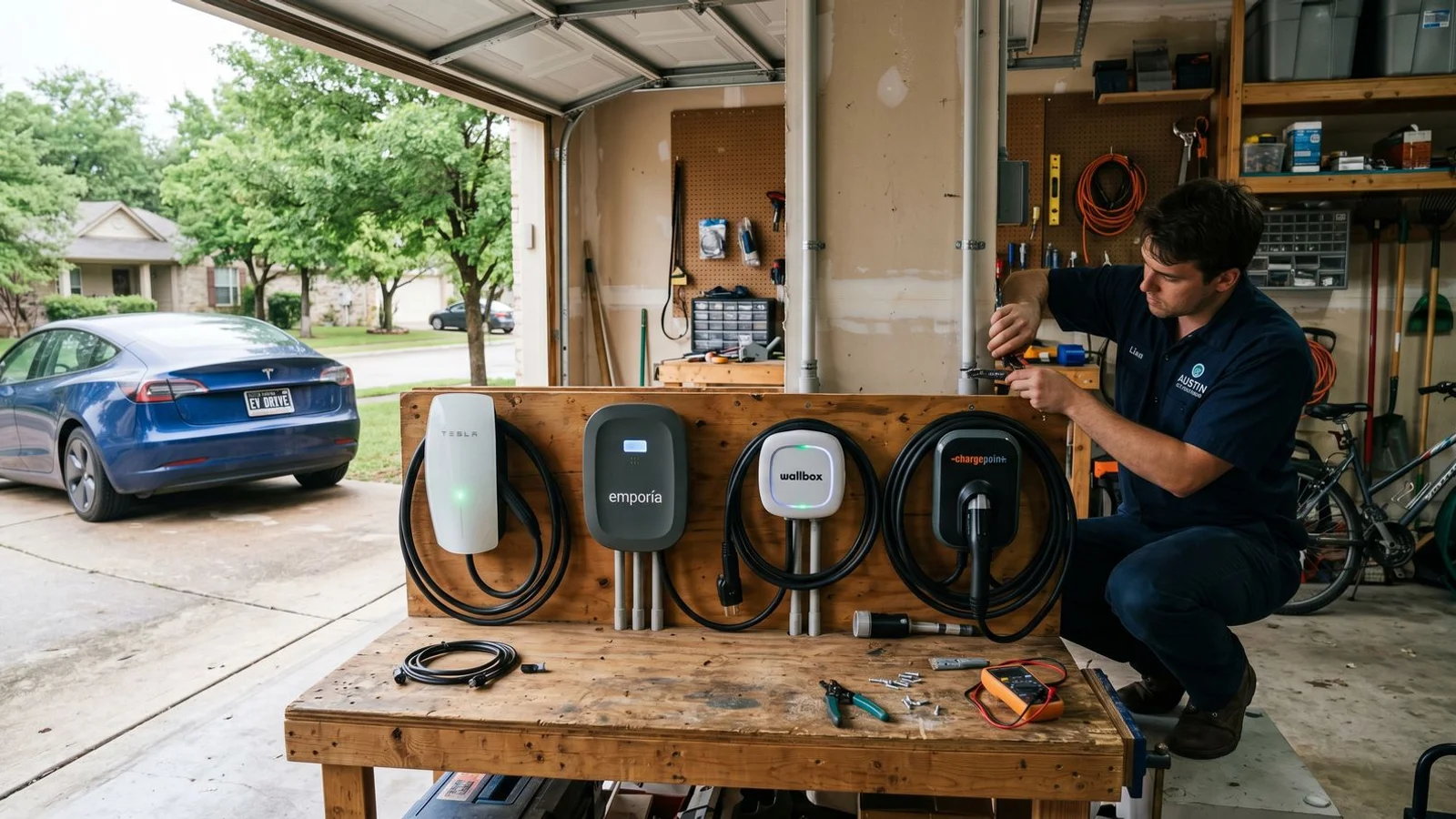
- Tesla family or 2026 NACS native: Choose a Tesla Wall Connector for a streamlined, native fit.
- Older non-Tesla considering NACS later: The Universal Wall Connector handles both plug types beautifully.
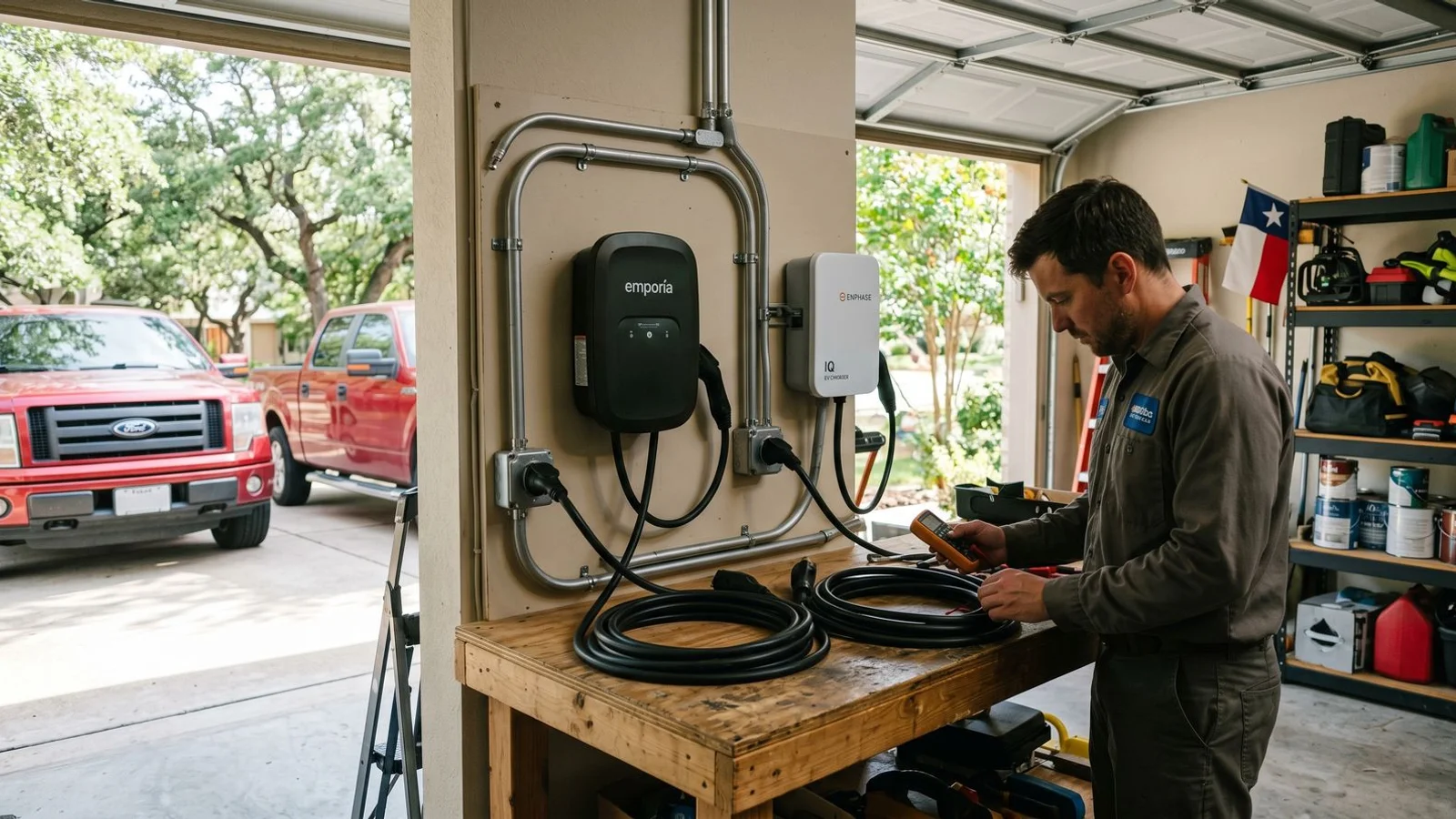
- Committed to legacy J1772: Dedicated stations from Wallbox, ChargePoint, or Emporia offer excellent smart features.
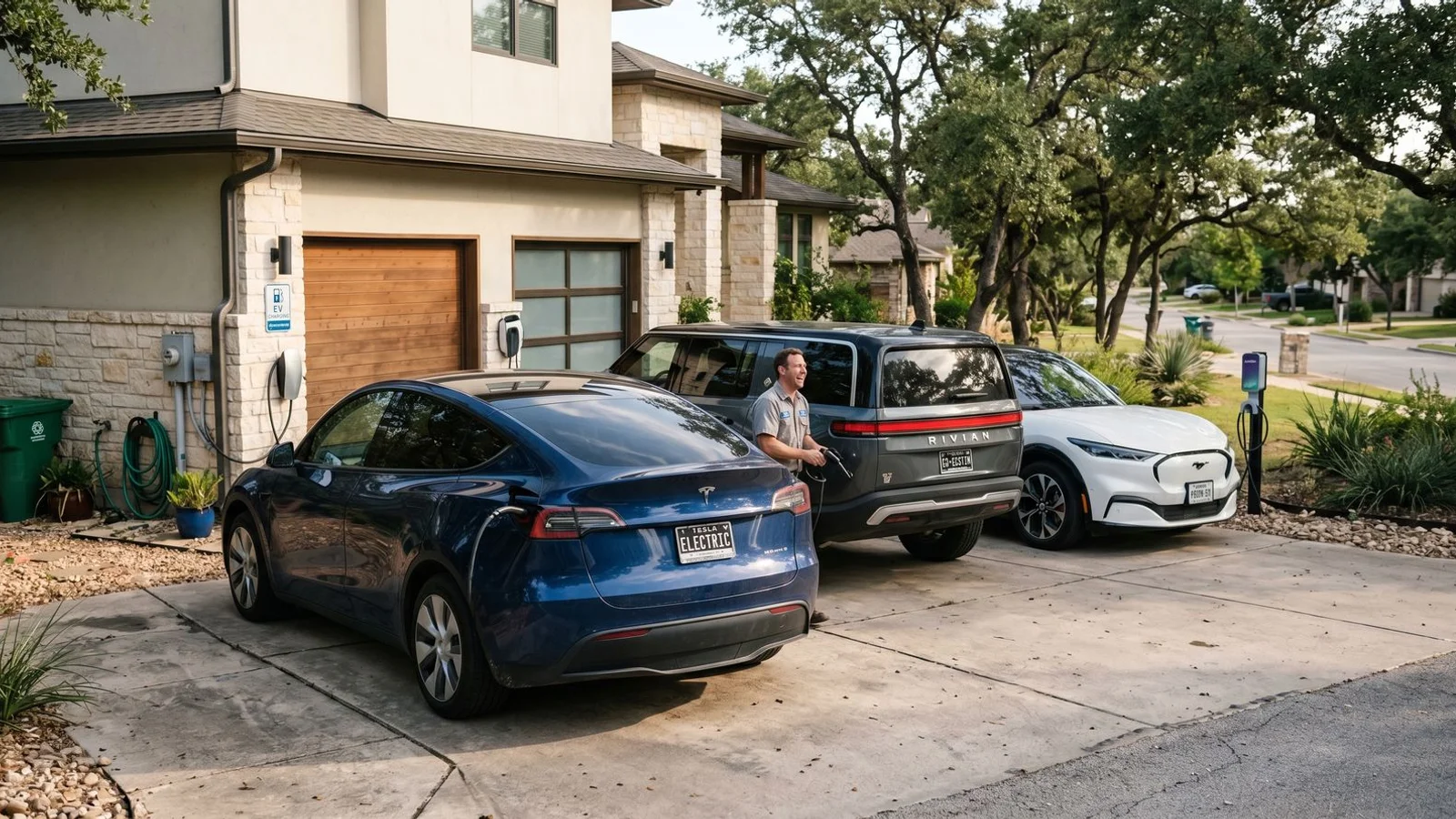
- Mixed manufacturer household: The Universal Wall Connector or a J1772 charger with a NACS adapter is the most flexible choice for sharing power.
Sizing Your Amperage
Our installation data shows that right-sizing your amperage prevents unnecessary panel upgrade costs. The National Electrical Code requires continuous loads to run at 80 percent of the circuit breaker rating.
- 48-Amp Station: This requires a hardwired setup on a 60-amp breaker to support a 48A car.
- 32-Amp Station: A 40-amp unit on a 50-amp breaker is plenty of power for a 32A car, or a great way to future-proof for your next vehicle.
- Smart Load Management: If your home is close to its 200-amp limit, devices like the DCC-9 can safely pause your charger when other heavy appliances turn on.
We highly recommend checking current incentives before purchasing equipment. The Federal Section 30C tax credit covers 30 percent of hardware and installation costs up to $1,000 for qualifying residential projects through June 2026. Taking advantage of this credit keeps high-quality hardware well within your budget.
Bottom line
Your car sets the real ceiling.
Our best advice is to buy a charger that matches or slightly exceeds your car’s onboard limit. Match the connector type to your current car. Always consider what your next car might use down the road.
See our multi-brand install service or get your free flat-rate quote.
Frequently Asked Questions
Why does my Ioniq 5 charge slower than my friend's Mach-E? +
Does my EV use J1772 or NACS? +
Should I oversize the charger for a future EV? +
Ready to talk specifics?
See our Multi-Brand Install service page for pricing and what's included, or get a free flat-rate quote.