case studies
Lakeway Install: How We Added a Fast Charger and Skipped a $4,200 Panel Upgrade
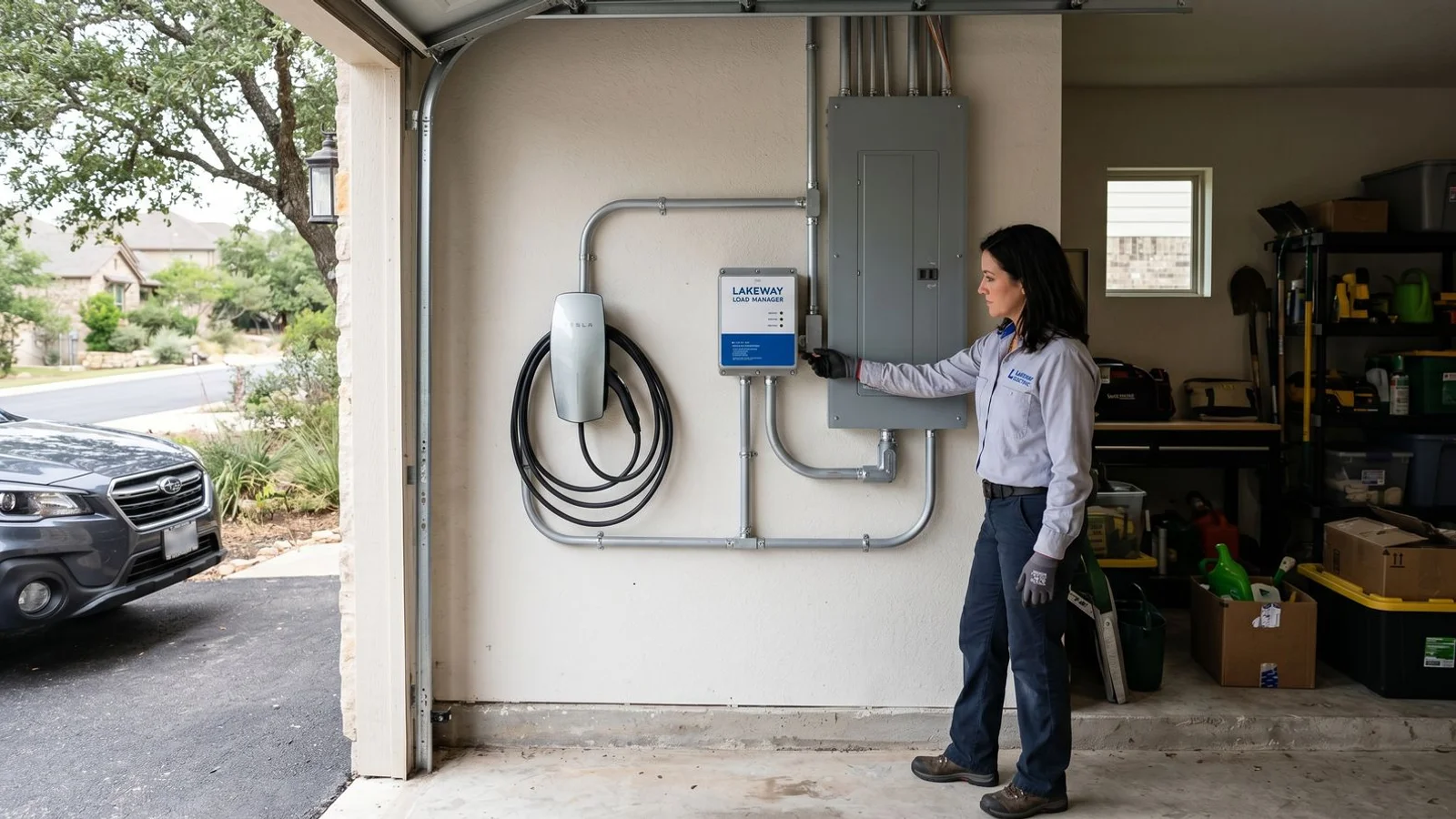
A Lakeway homeowner called us in May 2026 with a problem most Austin-area EV buyers eventually run into: another electrician had quoted them $4,200 for a 200-amp panel upgrade just to add a Level 2 charger for their new Tesla Model Y.
The garage already had a panel. There was a wall they wanted the charger on. There was a perfectly usable EV in the driveway. And there was a $4,200 bill standing in the way.
We installed a hardwired Level 2 charger with Group Power Management instead. Total cost was a fraction of the panel-upgrade quote. This is the kind of result our flat-rate home EV charger installation in Austin is built around. Here’s exactly how the install went and why it worked.
The problem with the original panel-upgrade quote
The home was built in the late 90s with a 150-amp main panel. The first electrician’s math went something like:
- House already pulls a lot (AC, electric water heater, pool pump)
- Add a 48A continuous EV charger
- Sum it up worst-case
- Recommend upgrading to 200A so nothing trips
That’s not wrong as a logic chain. It’s just expensive and usually unnecessary.
The hidden assumption is that the house pulls peak load on everything at the same time. Most homes don’t. NEC Article 220.87 lets us measure actual peak demand over time instead of assuming a worst-case sum. When we measured this home, the real peak was nowhere near 150A — there was plenty of headroom for an EV charger, as long as we could throttle it down on the rare moments when the AC, water heater, and oven all ran together.
That’s what load management does.
What we installed
The install took just over two hours on a Tuesday morning:
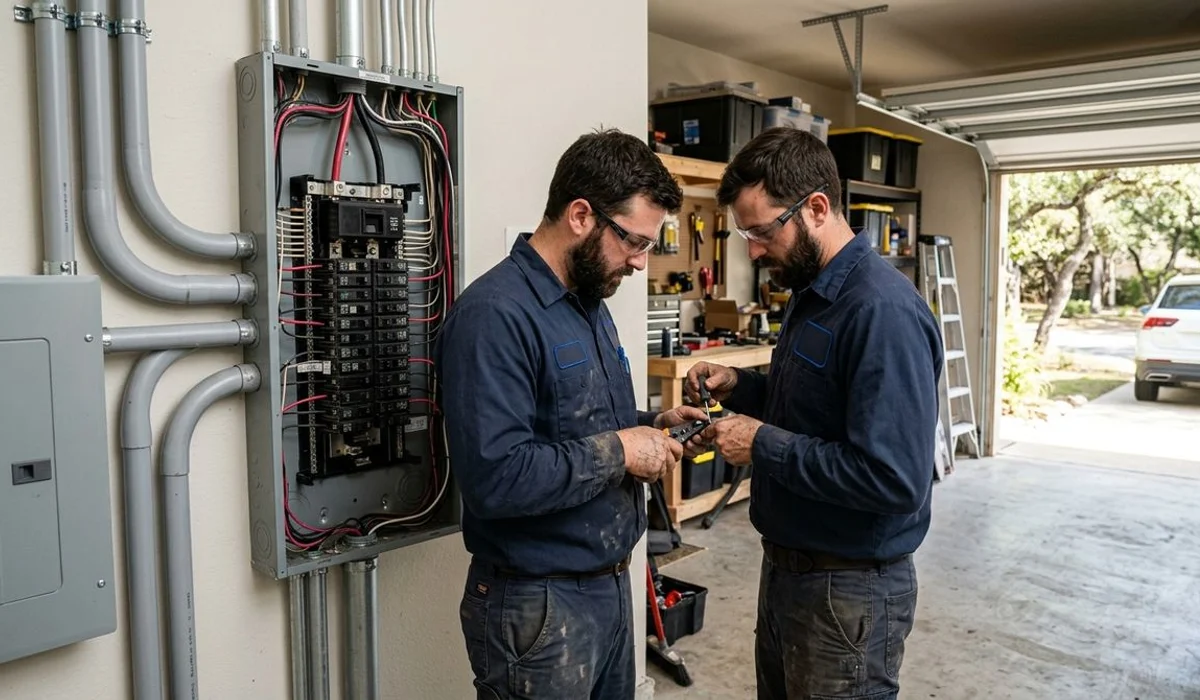
- CT clamps on the main service conductors. These measure the home’s real-time current draw.
- An Emporia Pro with PowerSmart load management module beside the panel.
- A dedicated 60A breaker for the new EV circuit.
- 6 AWG copper conductors routed in Schedule 40 PVC up through the wall and across the top of the garage — concealed, not surface-mounted across the wall.
- A Tesla Wall Connector mounted on the wall the homeowner specified.
- Commissioning: app setup, an NEC 220.87 calculation documented for the inspection, and a walkthrough.
The system now does this in the background: whenever the home approaches a load that would trip the main, the charger throttles down. When the load drops, it ramps back up. Most of the time, the car gets the full 48A. On a Texas summer afternoon when the AC pulls hard, it might slow to 24A for a few minutes. The homeowner doesn’t notice — the car still hits 100% by morning.
The numbers
| Item | Original quote | Our install |
|---|---|---|
| Panel upgrade | $4,200 | Not needed |
| Charger circuit | Quoted on top | Included |
| Permit / inspection | Quoted on top | Included |
| Total | $4,200+ before the charger | A fraction of that — flat-rate, all-in |
That’s not a marketing line. The homeowner had the $4,200 quote in writing. We have the install paperwork.
When load management isn’t the answer
We want to be honest here: load management isn’t always the right call. If a panel is aged out, has aluminum branch wiring causing problems, or simply too small for the rest of the household load even without an EV, an upgrade is the better long-term move. We’ll tell you that straight when we look at it.
But “the panel doesn’t have free breaker spaces” or “the service is only 150A” isn’t, by itself, a reason to spend $4,200-$8,000. For more on this decision, see our guide: Load Management vs a 200-Amp Panel Upgrade.
What this means for you
If you’re looking at a Level 2 charger install and an electrician has quoted you a big panel upgrade as the only path, get a second opinion before you sign. Get the actual reason they’re saying you need it. If it’s “you don’t have free breaker spaces” or “your service is too small,” load management may solve it for far less.
Get a free flat-rate quote. We’ll tell you straight whether you need an upgrade or whether load management gets you there.
About Marcus Hill
Marcus is the lead installer at Austin EV Charger Installation, overseeing 87+ home Level 2 installs across the Greater Austin area.